Introducing Pulse Surveys: Fast, Credible Audience Insight When Decisions Can’t Wait

Political, advocacy, and nonprofit communications teams operate in environments where the ground shifts fast. A news event breaks. A policy window opens. A campaign enters its final stretch. Decisions have to be made before formal research timelines can deliver answers.
The problem is familiar: traditional research cycles take weeks. DIY survey tools produce questionable data and put the full burden of setup, recruitment, and analysis on your already-stretched team. So important choices either stall or move forward without data inputs, putting campaigns, causes, and momentum at risk.
Today, we’re launching Pulse Surveys, a new product designed to close that gap. Pulse Surveys deliver fast, credible audience insight so teams can confidently move creative and messaging decisions forward between traditional research initiatives.
How Pulse Surveys work
The concept is simple. Your team writes up to fifteen focused questions. Grow Progress handles everything else: recruitment, targeting, fielding, and clean results. Within days, you have credible data you can act on.
Pulse Surveys use the same rigorous targeting infrastructure as our Audience Understanding Surveys and Rapid Message Tests, including reliable reach to low-engagement voters, independents, and hard-to-reach communities that DIY platforms and aggregator panels chronically miss.
No panel management. No data cleaning. No figuring it out yourself.
When to use a Pulse Survey
Pulse Surveys are built for the in-between moments of a campaign or issue cycle, when teams need clarity fast enough to actually inform the decision in front of them:
- Take a quick pulse on audience attitudes around an issue, policy moment, or news event
- Gut-check messaging and creative direction before committing to production
- Validate assumptions between larger research cycles
- Capture directional feedback during breaking news moments or fast-moving campaigns
- Answer follow-up questions that emerge after a major study
Fifteen questions is a ceiling, not a target. The more focused your survey, the more actionable your results.
What makes Pulse Surveys different
- Credibility that DIY tools can’t match. DIY platforms are fast but produce panel quality that is too unreliable for political and advocacy decisions.
- Speed that enterprise tools can’t match. YouGov, Morning Consult, and Ipsos offer credibility but are built for large research programs. Pulse delivers results in days.
- No DIY burden. You write the questions. Grow Progress handles the rest.
Where Pulse Surveys fit in the research suite
Pulse Surveys complement our existing research products. They never replace them.
- Audience Understanding Survey (AUS): Uncovers the underlying beliefs and values driving audience motivation
- Pulse Survey: Checks assumptions and narrows options quickly
- Rapid Message Test (RMT): Measures causal persuasive impact and proves what works
The key question: Do you need to know where your audience stands right now, or do you need to understand why they think what they think? If it’s the former, Pulse is the right tool.
Pulse Surveys in action: Voter attitudes on the Iran war and cost of living
To show what Pulse Surveys can do, we fielded a five-question survey to a representative sample of 789 registered voters nationwide between May 12 and 14, 2026. The goal: capture where the electorate stands on the war in Iran and its consequences on cost of living. Here’s what we found.
01 — Opposition to the war in Iran is broad
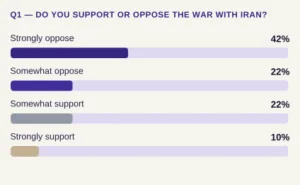
64% of registered voters oppose the war in Iran, including significant majorities among women, independents, and voters over 55. 35% of Trump voters also currently oppose the war in Iran, though Republicans remain the only segment where a majority of respondents support the war. Nonetheless, our research shows the audience receptive to an anti-war argument is substantially larger than the Democratic base alone, underscoring opportunities for persuasion. Also worth noting: the segment with the highest opposition to the Iran War (76%) are 2024 nonvoters — offering a potential motivation to win over disengaged voters.
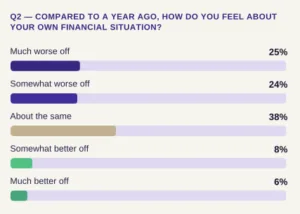 02 — Most voters feel financially worse off than a year ago
Only 14% of voters said they feel financially better off than one year ago. Half say it’s gotten worse. The sentiment that voters’ financial situations have gotten worse or stayed about the same since last year is a huge majority viewpoint across differences in age, gender, race, urbanity, and political ideology. One gap in views on economic outlook that stands out: only 35% of voters making over $100k per year feel they are financially worse off — compared to 57% of those making under $49k.
03 — Americans are more concerned about reducing costs than military engagement
When presented with a choice between military confrontation with Iran and focusing on reducing the cost of living, 67% of voters prioritize their household budgets over the war in Iran — including 85% of Democrats, 71% of independents, and 43% of Republicans. This viewpoint is particularly strong among key demographics in the Democratic base: over 70% of women, young voters, Black or Latino voters, and those making under $49k per year. Concern about economic conditions is outpacing support for the war across nearly every corner of the electorate.
 A 67-point majority prioritizing household budgets over military engagement is a potential persuasion asset — but unlocking it requires knowing which messages translate that sentiment into action. That’s exactly what Rapid Message Testing is built for.
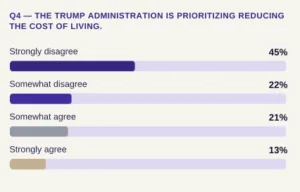 04 — Most Americans don’t think Trump is prioritizing the cost of living
67% of voters disagree that the Trump administration is prioritizing reducing the cost of living. That skepticism runs deep into key segments of the Republican coalition: 65% of white voters, 60% of non-college voters, 64% of high-income voters, and 61% of rural voters don’t agree that Trump is prioritizing the cost of living. Voters across the spectrum are already unconvinced Trump is putting their financial situations first. They might be on to something.
05 — Voters blame the Iran War for rising prices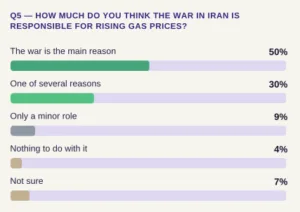
80% of voters think the war in Iran is mainly or partially responsible for rising gas prices. There is no segment we surveyed where a majority of registered voters did not connect the war with the recent rise in gas prices — including 80% of Republicans, who are actually more likely than Democrats (60%) to make this connection.
What This Means for Campaigns
Taken together, these findings describe an electorate that is anxious about their finances, opposed to a war that they feel is making things worse, and broadly skeptical that the Trump administration is focused on their financial situations. While these views are almost universal among Democrats, similar concerns are growing among large segments of Republicans and Trump supporters. Many of the perspectives that may sway voters towards Democratic candidates this midterm cycle are already being reflected in the pulse of American opinion. Our prior research found that messaging pairing Republican failures with specific Democratic action produced the strongest vote-choice effects we tested. This pulse survey suggests that registered American voters may be primed for exactly that approach.