Conservation Law Foundation: From Gut Instinct to Research-Backed Climate Messaging
About Conservation Law Foundation
Conservation Law Foundation (CLF) is a New England–based environmental advocacy organization that has been fighting for clean energy, healthy communities, and environmental justice for 60 years. Using the law, policy, and markets, CLF has racked up landmark wins — from the cleanup of Boston Harbor to shutting down every coal plant in New England to stopping oil and gas drilling in the Atlantic.
The Problem
Many of CLF’s advocacy wins in the last 10 years — stopping pipelines and shutting down coal plants — were relatively straightforward to message. But as the organization’s work shifted toward more abstract policy goals like state-level climate legislation, grid modernization, and emerging clean energy technologies, the communications team hit a wall.
“We went from more concrete wins like ‘we stopped this power plant’ to these more abstract ideas that we were struggling with,” said Laurie O’Reilly, Associate Vice President of Marketing and Communications at CLF. “Climate laws, modernizing the grid, emerging technologies — these are harder to ground in everyday life.”
The environmental movement had long relied on technical language, legal framing, and fact-heavy messaging — approaches that resonated with environmental movement insiders but failed to move broader audiences. CLF’s communicators knew instinctively that values-based, emotionally grounded messaging would perform better, but they had no way to prove it to internal stakeholders or to know which specific frames would land in their New England markets.
Academic research offered some guidance, but it didn’t translate neatly to local contexts. “There are a lot of academic papers saying ‘this message frame works best’,” said Rishya Narayanan, CLF’s Climate Communications Manager. “But when you think about contextualizing it at a local level to New England states, within certain issue topics like fossil fuel usage or gas stoves, that might not always hold true.”
The Solution
CLF began working with Grow Progress in mid-2023 to bring research-backed rigor to their messaging strategy. Using Rapid Message Tests (RMTs) and Audience Understanding (AU) surveys, CLF could finally test assumptions, validate creative instincts, and build campaigns on evidence rather than guesswork.
Tapping the Persuasion Library for faster, smarter message development.
When CLF needed to develop messaging around New Hampshire climate legislation, O’Reilly turned to Grow Progress’s Persuasion Library — a database of tested messages and results from across the platform. She found a winning message frame from a Michigan campaign, adapted it with New Hampshire–specific details, and put it into testing. That adapted message became the top performer — and CLF still uses it three years later.
“Having the Persuasion Library so that we didn’t have to figure out all of this from scratch was really transformative,” O’Reilly said. “I took one of the messages from Michigan, changed the specifics to make it relevant to New Hampshire, and that message ended up being the winner.”
Using Audience Understanding surveys to build campaigns from the ground up.
When CLF wanted to promote heat pump adoption across New England, they resisted the urge to jump straight into message testing. Instead, they ran an AU survey to understand how people actually felt about the technology. The results challenged their assumptions: people were curious about heat pumps but had deep reservations about cost, cold-weather performance, and the fact that nobody they knew had actually installed one.
“We wouldn’t have been able to do any of this without the Audience Understanding survey,” Narayanan said. “I think we would just be throwing spaghetti at the wall if it wasn’t for that.”
Validating what works — and retiring what doesn’t.
CLF also uses Grow Progress to pressure-test messaging they’ve relied on for years. Early testing on gas appliance transitions, for example, revealed that indoor air quality and safety frames — approaches endorsed by academic literature — actually generated backlash with their target audiences. That finding saved CLF from investing in a messaging strategy that would have undermined their goals.

The Impact
A winning message with staying power. The New Hampshire climate messaging CLF developed using Grow Progress has been in active use for three years, deployed across advertising, advocacy communications, and organizer toolkits. The message — grounded in everyday New Hampshire experiences like shorter pond hockey seasons and declining moose populations — consistently outperforms abstract policy language.
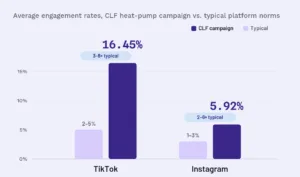
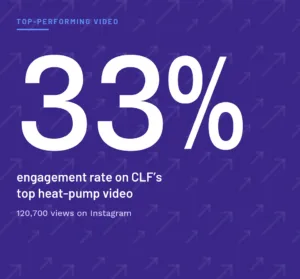
A campaign built on real audience insight. The AU survey findings shaped CLF’s entire heat pump campaign strategy: educate first, bust myths about cold-weather performance, and use real people — including social media influencers — to show heat pumps working in actual New England homes. Narayanan called it “a very successful campaign,” one that would not have been possible without the research foundation. The benefit of running an AU was clearly reflected in how the campaign performed, blowing past many benchmarks on multiple platforms. Four videos surpassed the benchmark engagement rates on Instagram and TikTok; one in particular reached 120,700 views and a 33% engagement rate on Instagram:
1) Average engagement rate on TikTok: 16.45% (typical benchmark is 2-5%)
2) Average engagement rate on Instagram: 5.92% (typical benchmark is 1-3%)
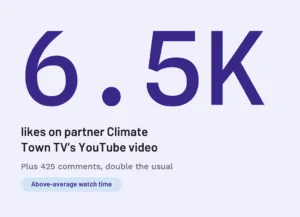 Climate Town TV, a partner, noted they saw above average engagement and view duration on YouTube and Instagram. Their video received 6.5k likes and 425 comments on YouTube, which is more typical for a video with double the views.
Internal credibility for the communications team. In an organization full of lawyers and policy experts, having tested evidence behind messaging recommendations changed the dynamic. O’Reilly can now walk into internal conversations and say with confidence which frames move people — and which don’t.
“Being able to go into the Grow Progress platform and say, ‘Here’s what worked. Here’s how much this moved people. Here’s what didn’t move people the way you want to talk about it’ — that has really been game-changing,” O’Reilly said.
Easier handoffs to partners and consultants. Narayanan distills Grow Progress results into messaging toolkits and communications plans that travel well beyond the CLF communications team — to coalition partners, hired consultants, and advocacy staff in the field. The platform’s AI-generated overviews make that synthesis faster.
“The AI overview summary is so clean, so skimmable, and so easy to read for a non-technical expert like me,” Narayanan said. “I’ve been able to share that with internal folks and consultants. It’s just such a nice snapshot of what worked, what didn’t, and what the next steps are.”