How American Independent Radio Inspired Voter Turnout in the 2024 election
When every vote counts, every message matters. See how AIR used testing to optimize radio ads designed to motivate and mobilize voters across the nation to turn out and vote.

People rarely test messaging solely to shift attitudes. We pre-test with the implicit hope that attitude shifts will translate into behavior change – voter turnout or vote choice in electoral contexts. An effective messaging strategy is built on the premise, or evidence, that changing certain attitudes will lead to desired behaviors. For voter turnout efforts, the connection between attitude and behaviour remains particularly elusive – the link between how much a person says that they intend to vote and whether they actually cast a ballot days or weeks later is far from certain.
When American Independent Radio needed to develop turnout messaging in 2024, they partnered with Grow Progress to pioneer an approach that acknowledged this limitation while still providing actionable insights. Rather than attempting to predict turnout directly, we focused on testing whether messages successfully delivered on their underlying theoretical premises – providing a foundation for strategic decision making.
The Testing Challenge & Approach
Despite extensive research, the field has yet to identify a survey measure that reliably and consistently predicts voting behaviour. This disconnect creates a fundamental testing dilemma: if we can’t reliably measure turnout impact in surveys, how do we know which messages might work?
While using previously field-tested messaging is one approach, the 2024 election presented unique challenges. Vote motivation was reported to be low, and using previously validated mechanisms—like providing election information, or social pressure—alone seemed insufficient to reach disengaged voters. We needed to develop additional messaging frames to meet the moment.
Grow Progress and AIR tackled this testing challenge by designing an approach based on a simple premise: while we can’t directly test if messages increase turnout, we can test whether they successfully shift specific attitudes that might drive voting behavior. While this testing wasn’t designed to validate the attitude-to-behavior link, messages that failed to shift attitudes they were targeting almost certainly wouldn’t drive turnout.
Data That Informs Action
Using the Rapid Message Testing tool, AIR designed an experiment to assess the persuasive power of three distinct message frames:
- Stakes: Emphasizing the critical importance of the election’s outcome.
- Empowerment: Highlighting how voting was a way to claim and exercise a citizen’s power.
- Single Vote: Demonstrating how a single vote can tip the scales in close elections.
AIR tested ten scripts across the three message frames. The results were revealing: only four messages showed statistically significant effects in shifting their target attitudes. Interestingly, three of these successful messages came from the Single Vote frame.
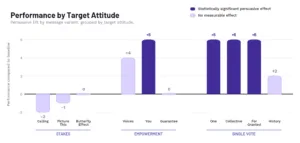 The testing process proved invaluable not just for identifying what worked, but also for discarding assumptions. Despite the initial hypothesis that all three frames would be viable, the data clearly showed that the Stakes and Empowerment scripts weren’t effectively shifting attitudes with the messaging that AIR had developed. Rather than proceeding on intuition alone, AIR was able to make data-driven decisions, focusing resources exclusively on messages proven to deliver to their theoretical premise.
A Model for Pre-testing GOTV Messaging
Rather than skipping testing altogether because impact on their final desired outcome wasn’t possible, AIR’s collaboration with Grow Progress allowed them to move forward with decisions grounded in evidence.
For organizations developing untested voter turnout messaging strategies, attitude testing represents a necessary first step – not because attitude shifts guarantee turnout, but because they’re a prerequisite for the desired behavior change.
While insufficient on its own to prove impact on actual voting, this testing approach provides critical value in two scenarios: as an essential screening tool before resource-intensive field tests, and as the best available guidance when field testing isn’t feasible due to time, technical, or resource constraints.
Through Rapid Message Testing, American Independent Radio not only boosted their chances of campaign effectiveness but also championed a data-driven model for motivating voters in one of the most consequential elections of our time.