The Problem in the Bottom Right Corner of Your Ad: Pre-testing for Skippable Video Platforms
If your ad buy will be skippable, some of your pre-testing should be too
Attention is a prerequisite for persuasion, so what would an ad have to look like for you personally to choose not to skip it? If you’re anything like us, even imagining such an ad can feel challenging.
Making ads for skippable inventory adds yet another layer of complexity to modern advertising. Do you try to squeeze your entire message into the first few seconds, or do you set up a story that makes watching longer worth considering? Do the viewers who skipped represent your most high value targets, or folks who were unlikely to support you anyway? Ultimately, how do you balance optimizing the creative to hold attention with the hard work of persuasion?
In this post, we’ll introduce a new Grow Progress offering —the Skippable Video test format —which allows pre-testing to inform many of these difficult decisions.
What’s a Skippable Video Test?
Normally, when you test an ad with Grow Progress’ Rapid Message Testing tool, we randomize respondents into two conditions: a treatment group that sees your ad and a placebo group that sees an unrelated ad. The difference in responses between the two groups then gives an estimate of the effectiveness of your ad, just like in a medical trial.
In a Skippable Video test, we mirror the environment of YouTube or your target platform, allowing users to skip after a 5-second countdown (or a custom duration). We monitor which respondents skip and when, providing the data you need to untangle how “skippability” changes your ad’s performance.
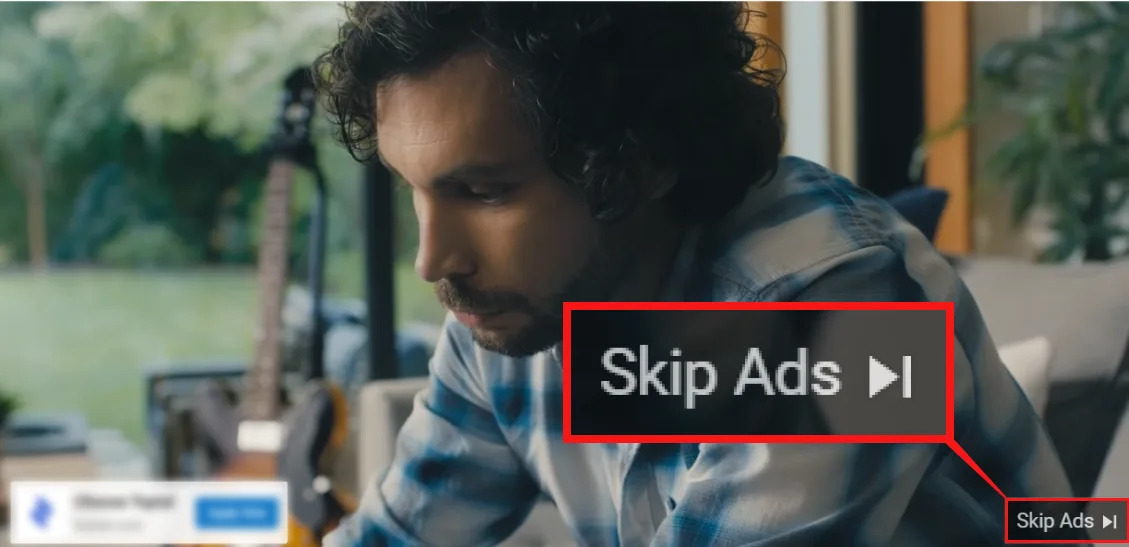
At a basic level, this allows you to see how your ad is moving viewers on your key success questions (e.g., trust, favorability) even if some viewers choose to skip as they might in the real world.
Going deeper, we provide per-ad skip rates and average viewing durations, which help explain why ads might perform the way they do in a skippable context. By quantifying which demographic groups skipped each ad and how quickly, you can understand whether you’re holding the attention of your key audience segments. Alongside treatment effects, these metrics are valuable both for choosing between possible creatives and further iterating on your ads.
In the limited testing we’ve done so far, the most persuasive ad is not always the one that retains the most attention. This underlines the importance of measuring persuasion and attention at the same time. Those with the highest treatment effects may not be the best at retaining attention, and vice versa. This emphasizes the importance of testing for persuasion and attention in an integrated way, as considering these alone may paint an incomplete picture.
How “Brainrot” Video Performs in Political Ads: Case Study Early Findings
In partnership with The States Project and Tavern Research, we ran an early pilot study testing ad skippability in Delegate Joshua Cole’s 2025 Virginia race. We compared three formats: a traditional campaign video, a direct-to-camera (DTC) message from Cole, and a “brainrot”-style ad—pairing a rug-cleaning video with campaign messaging.
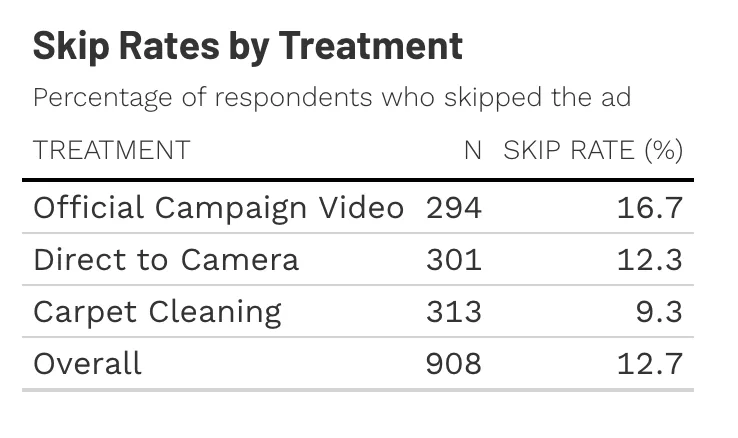
All three improved Cole’s favorability, but the DTC ad performed best overall, driving the only statistically significant lift for the Democratic Party as well. The brainrot-style ad, however, was skipped the least—suggesting strong attention retention despite weaker persuasion effects.
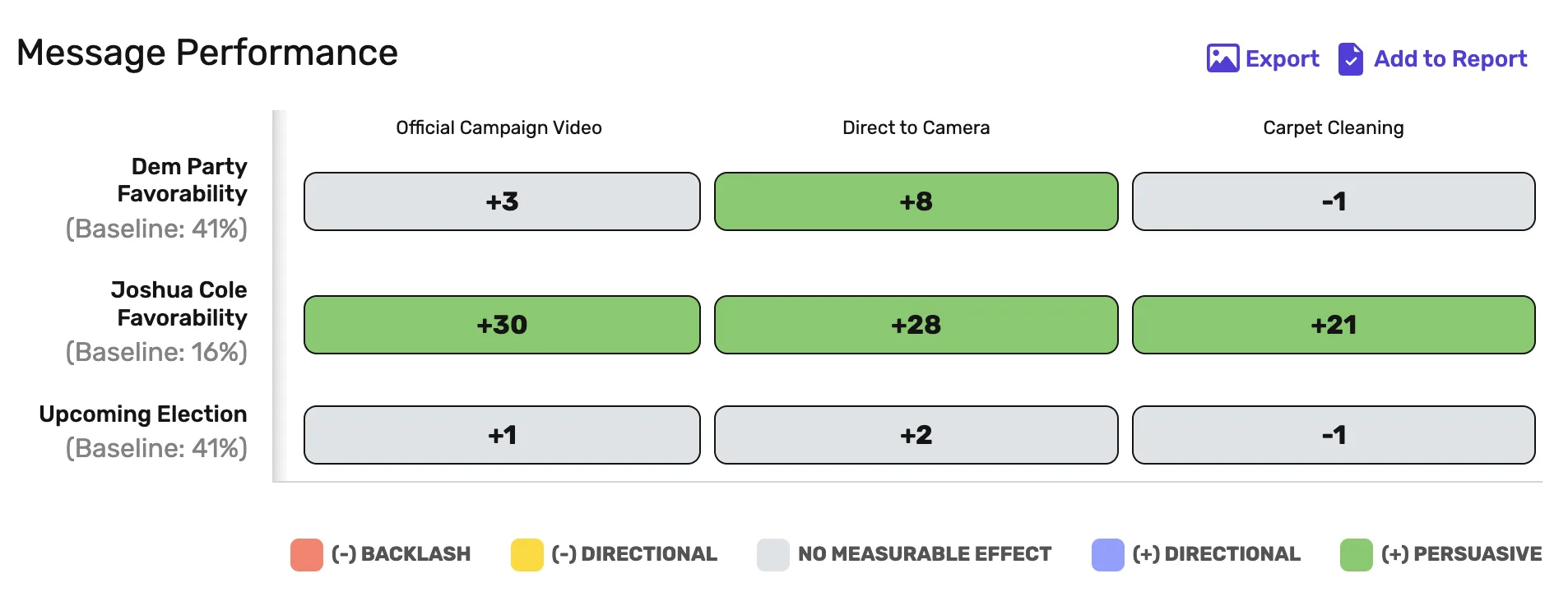
While skip rates were lower than expected in this controlled setting, they still provided meaningful signal on audience attention. One consistent insight: less engaged voters skip ads at far higher rates, underscoring the need to design creative that can hold their focus.
A deeper dive into these results—and what they mean for future campaign testing—will be available soon in our full case study.
Skippable Video Testing in the Larger Attention Measurement Toolbox
While not appropriate or necessary for every pre-testing plan, many digital-forward organizations can benefit from testing their creative in this skippable format. While many advertising platforms provide this level of data on ad viewing behavior during or after large campaigns, we believe integrating this attention signal into pre-testing offers an opportunity to iterate faster and at a meaningfully lower cost.
As we work with clients to integrate this and other attention-focused tools like breakthrough testing into their workflows, we’re excited to share what we’re learning. We hope this introduction to the Skippable Video test was as fascinating to you as it is to us!