New Research Shows Even Trump Voters Are Rethinking ICE
Four takeaways from our rapid message test following the crisis in Minneapolis
In the days after the murders of Renee Good and Alex Pretti and subsequent “ICE Out” protests throughout Minnesota, Grow Progress mobilized with American Immigration Council and International Refugee Assistance Project to conduct a Rapid Message Test and gauge voter persuadability on the administration’s current approach to immigration enforcement.
Together, we tested 8 differently themed messaging campaigns on a randomized, nationwide sample of American adults and then measured movement on responses to questions like “Overall, do you approve or disapprove of the way President Trump is handling immigration?” compared to responses from a baseline placebo audience.
Ready to set your 2026 research plan? Sign up today to get started.
Republican voters are changing their minds about ICE, Trump’s handling of immigration
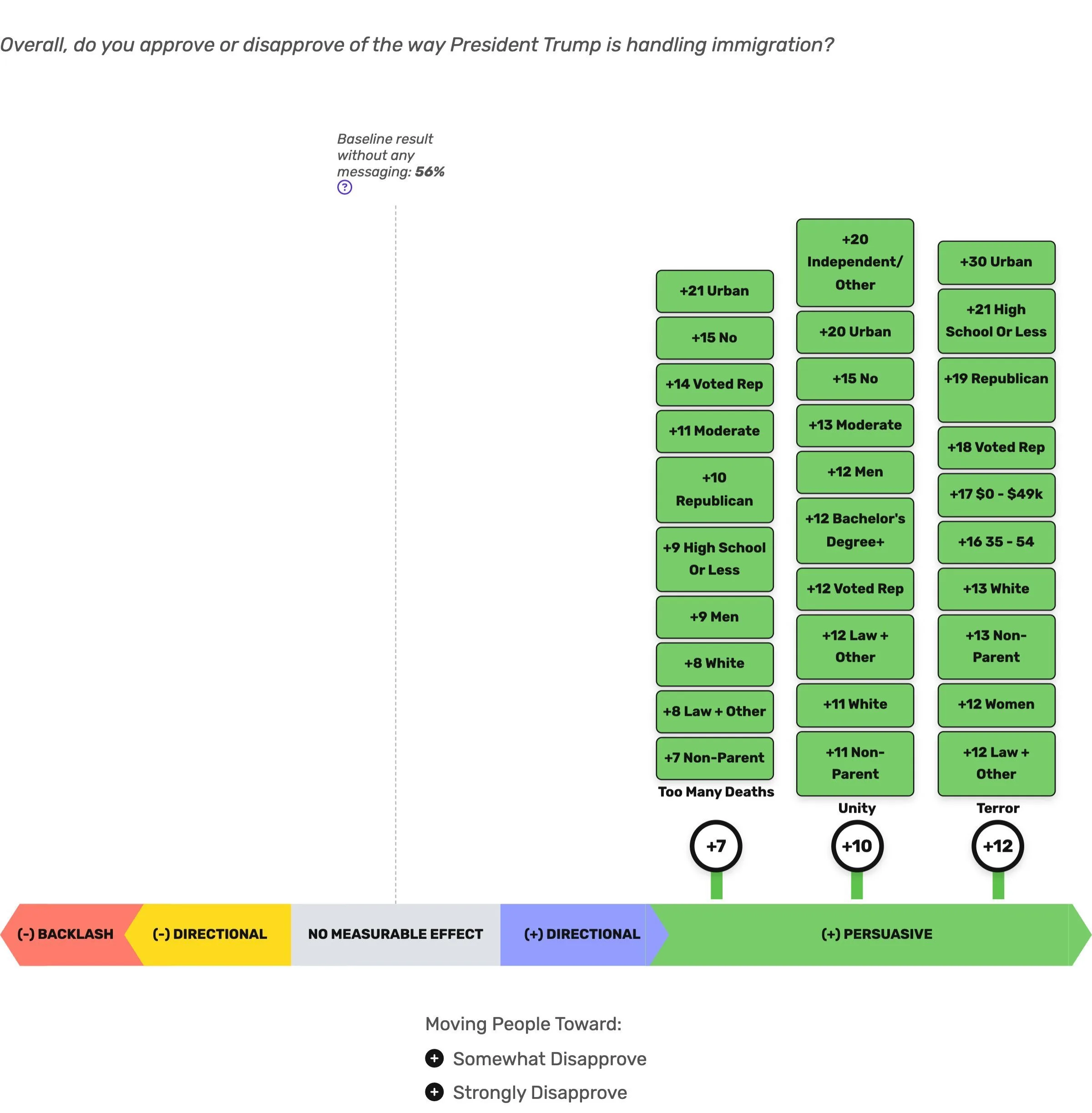
In our test, the most successful messaging moved Trump voters +18 and Republicans +19 points against current ICE policies and Trump’s handling of illegal immigration. Meanwhile, following the same messages, independent voters shifted a whopping +20 points.
Overall, across all audiences, 7 of the 8 messages increased disapproval of ICE tactics, and 6 of the 8 increased disapproval of Trump’s handling of immigration.
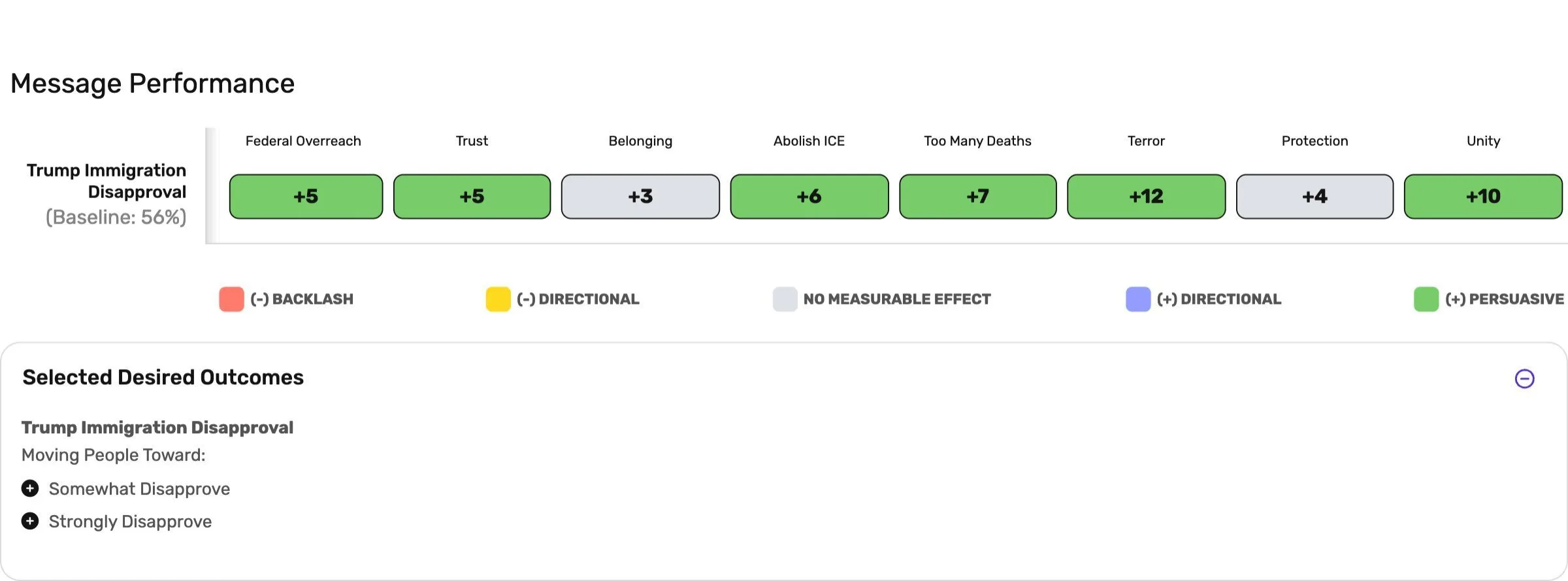
This indicates a significant window of opportunity to persuade large blocs of voters on this issue ahead of the midterm election cycle. More testing is needed to determine whether this has led to shifts in other key issues.
“As immigration enforcement in Minnesota escalated to detaining refugees and terrorizing communities, we knew our messaging had to meet the moment. We crafted messages to tap into public outrage and bring in new supporters, though we couldn’t be certain how they would land.
Grow Progress’ messaging study validated our approach and reinforced that this is a moment to lean in, not pull back, on messages that highlight the lawlessness and urgency of this watershed moment. It has also been a powerful opportunity to demonstrate our team’s impact, both internally and externally.”
Henrike Dessaules, Senior Director of Communications, International Refugee Assistance Project
International Refugee Assistance Project is a global legal aid and advocacy organization working to create a world where refugees and all people seeking safety are empowered to claim their right to freedom of movement and a path to lasting refuge.
Respondents prioritize public safety, but want Trump and ICE to focus on minimizing community harm
None of the message campaigns led to a rejection of ICE activity outright or a decrease in prioritizing public safety. However, following the events in Minneapolis, many respondents no longer see ICE’s aggressive enforcement tactics as aligned with public safety, and are becoming increasingly concerned about community harm.
In fact, no message effectively decreased support for strong enforcement regardless of consequences to community harm.
Meanwhile, even though the majority of messages did not mention the Trump administration explicitly, 6 out of the 8 total messages led to an increase in disapproval of Trump’s handling of immigration. This indicates that voters are already implicitly tying the views on ICE to their approval of the Trump administration.
Some traction gained with “abolish ICE” messaging, but middle ground approaches also proved persuasive
Messaging including language like “abolish ICE”, “ICE agents are terrorizing refugee communities”, and “it’s time to put a stop to these violent operations” proved most effective in increasing disapproval of Trump and current immigration enforcement policies (+18 Trump voters, +30 urban residents).
However, more moderate approaches (“all Americans should reject these attacks on our neighbors and our constitutional rights”, “strong communities are built on trust, not fear”) also moved the needle, in particular for some typically hard-to-persuade demographics like independents and Republican voters from 2024 (+12 Trump voters, +13 moderates).
Meanwhile, softer messaging centered around the overreach of the federal government (“strong communities depend on collaboration, not federal overreach that disregards local voices”) and belonging (“thriving communities are built on belonging and mutual respect”) proved to be less persuasive (+10 Trump voters, +10 independents).
“I appreciated so much the speed and timing with which Grow Progress was able to set up, finalize, and field this test. When you work on something that dominates headlines nearly every other week, it can be hard to get a sense of when the topic is breaking through and meaningfully affecting public opinion. We felt instinctively that that may be happening in real time, and the Grow Progress team helped us get a much needed evidence-based pulse—very quickly—at a critical moment to help shape our communications, advocacy, and community-based work.”
Kimberly Serrano, Director of the Center for Inclusion and Belonging, American Immigration Council
The American Immigration Council works to create a nation where immigrants are embraced, communities are enriched, and justice prevails for all.
Views on Trump and aggressive ICE tactics are changing for a number of demographics, including young men, non-college voters, and nonvoters
A wide range of subgroups, in particular among demographics loyal to Trump in recent election years, showed movement on their views on current immigration enforcement policy in response to our partner message campaigns.
This includes, at their highest persuadability: “High school or less, +21”, “White +13”, “Urban +30”, “$0-$49k income +17”, “ages 35-54 +16”, and “women +12”.
This movement suggests that, with the right messaging, growing sentiment against ICE policies could be leveraged to win back a number of demographics where Democrats have seen slippage in the last election cycle.
Additionally, our results show movement among nonvoters (+12), indicating that this issue could be powerful enough to bring some Americans who typically stay at home back to the ballot box.
Next Steps
This Rapid Message Test, conducted in partnership with American Immigration Council and International Refugee Assistance Project, provides a powerful example of how our tools and research can be leveraged to learn more about target audiences, test persuasion strategies, and identify opportunities for movement among voters right now.
More experimentation is needed, and with the midterms quickly approaching, we have an important window of time to test, iterate, and land on the most effective messaging strategies to move large blocs of voters.
So, what’s your current plan for message testing?