Audience Research Insights: What a New Survey Reveals About AI Data Centers
AI data center development is accelerating across the United States. New projects are being proposed in more places, more often. This means that in many communities, policies and opinions are forming just as quickly, often before people have a full picture of what these projects actually involve.
But what’s less clear is how people actually feel about AI data center development. Not just in broad terms like “support” or “oppose,” but:
- What concerns are driving hesitation
- What people believe will happen in their communities
- And what ultimately shapes whether they support or push back
To better understand this, Grow Progress conducted a national Audience Understanding Survey of U.S. adults using modern audience research and survey tools designed to capture both quantitative and qualitative audience data. Here’s what we found:
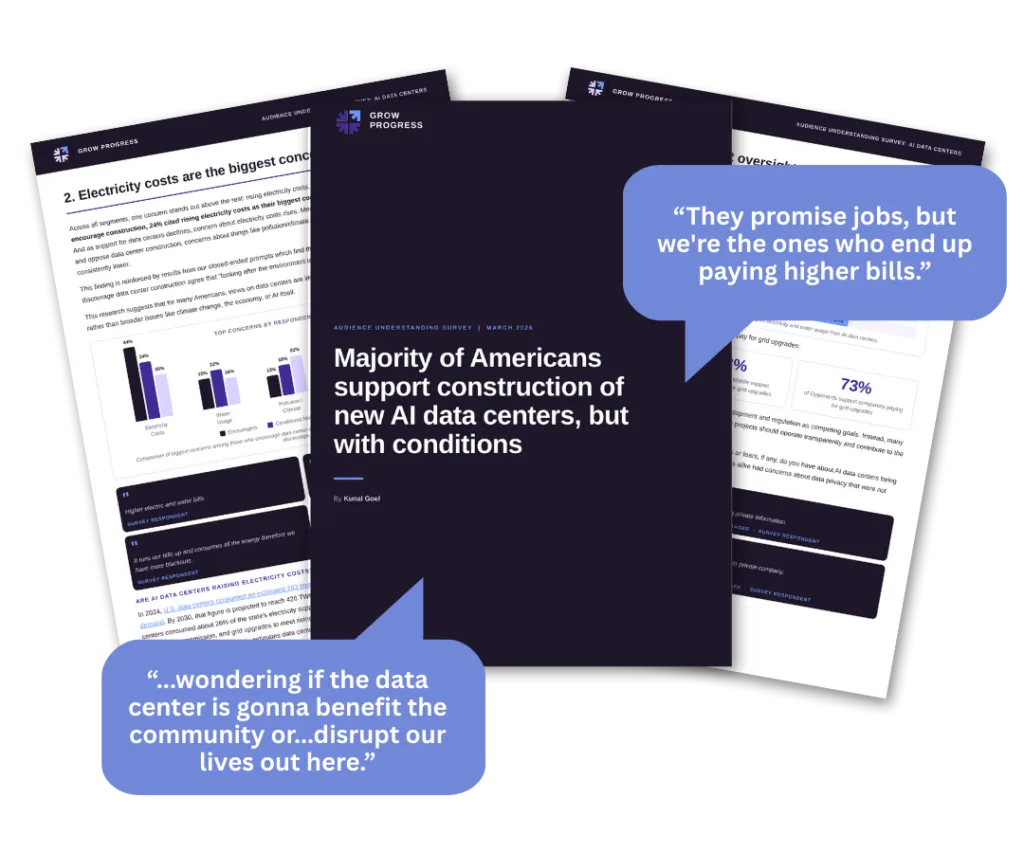
Access The AI Data Centers Report
What Audience Research Reveals About Public Opinion on Emerging Technologies
When new technologies emerge, public opinion doesn’t show up fully formed. It develops in pieces. People react to what they hear, what they read, and what they see happening in their communities. Early impressions often come from incomplete information, but those impressions still shape how people evaluate new projects.
That’s especially true for something like AI data centers. For most people, this isn’t an issue they’ve thought deeply about before. It’s not tied to a clear political identity. And it doesn’t yet fall into a familiar “for or against” category.
That makes it harder to read, but also more important to understand. This is where audience research becomes useful. Traditional polling can tell you where people land at a given moment. It can show levels of support or opposition, and how those vary across demographic groups. But with emerging issues, that’s only part of the picture.
What matters just as much is:
- What people think is at stake
- How the issue connects to the underlying values people hold
- How they interpret potential tradeoffs
- What kinds of outcomes they expect in their communities
Those are the inputs that shape opinion before it hardens. Effective audience research focuses on these layers. It looks at how people are making sense of an issue, not just where they end up — and that distinction matters. If public opinion were already fixed, the job would be to respond to it. But when opinions are still forming, communication plays a larger role in shaping public narratives.
Market Research Methods: Survey Tools and Demographic Targeting Used in This Study
To understand how people think about AI data centers, we needed more than a simple read on support or opposition. We needed to understand how people were forming their views.
The study conducted by Grow Progress used an Audience Understanding Survey, which combines several market research methods into a single approach. It brings together structured survey questions with open-ended and closed-ended responses, using both traditional survey tools and more advanced audience research tools to capture a deeper level of audience insight.
The survey was conducted with a randomized, national sample of U.S. adults, with respondents grouped based on how they initially viewed AI data center development. From there, we asked people not just what they thought, but what informed those beliefs. Open-ended responses allowed people to describe their concerns, expectations, and assumptions in their own words. That layer changes what you can learn.
The end result is a comprehensive segmentation of where the American public stands on data centers.
Two people with similar demographics can come to very different conclusions about the same project. They may trust different institutions, prioritize different risks, or interpret the same information in completely different ways. That’s where audience insights and deeper consumer insights become more useful than demographics alone.
By combining demographic targeting with qualitative responses, this approach produces a more complete view of the audience. You can see patterns across groups, but also understand the reasoning behind those patterns.
For example, instead of simply identifying that a group is concerned about energy use, you can see how they talk about that concern. You can understand whether they’re thinking about cost, reliability, fairness, or something else entirely. That difference is what makes the insights more actionable. It allows teams to move from knowing that a concern exists to understanding how to address it.
Audience Insights Revealed — What Did Key Demographics Think About AI Data Centers?
When you look at the topline numbers, it’s easy to summarize public opinion on AI data centers as broadly supportive. But that framing misses what’s actually going on underneath.
Most people are not taking a fixed position. They’re weighing tradeoffs. And those tradeoffs are shaped by a few consistent concerns that show up across different groups.
Most Americans Support AI Data Centers — But With Conditions
Our survey finds that nearly 6 in 10 Americans are open to AI data center development in some form.
The single largest segment, one-third of respondents, says development should only proceed with strong rules and safeguards in place.
People want to understand how these projects will affect their communities and what the broader data center impact on the community will be. They are also paying attention to whether the benefits feel real or theoretical.
This group doesn’t require a complete change in position. But their support is not guaranteed either. It depends on how the issue is explained and what concerns are addressed along the way.
Data Center Pollution and Environmental Impact
Concerns about the data center environmental impact come up frequently, but they are not always framed in the way teams expect. People are thinking about AI data center environmental impact, but often through more immediate, practical questions.
AI Data Center Energy Consumption
One of the most consistent themes across responses is energy use.
People are asking versions of the same questions:
- How much power does an AI data center use
- What does this mean for local infrastructure
- And whether increased demand will affect their electricity costs
In our survey, electricity costs were the top concern across all respondent groups — including among those who support development.
This reflects a broader concern about AI data center energy consumption and rising utility prices especially as projects scale. In many cases, this is less about climate in the abstract and more about day-to-day impact. Will this make energy less reliable? Will it make it more expensive?
That framing shows up across different demographics, even among those who are otherwise supportive of development.
AI Data Center Water Usage
Water usage is another area where concern is starting to emerge. While it comes up less frequently than energy, it is often tied to local context. Respondents mentioned questions about water availability, long-term sustainability, and whether these projects compete with other community needs.
As awareness grows, AI data center water usage is likely to become a more visible part of the broader conversation around data center impact on the environment.
Data Center Industry Jobs Impact
Economic benefits are part of how many projects are positioned, and job creation is often a central argument tied to data center industry jobs impact. But the research shows that this doesn’t always land the way teams expect.
Some respondents see clear potential for economic growth. Others are more skeptical. They question how many jobs will actually be created, who those jobs will go to, and whether they will benefit the local community.
Only 5% of those who oppose data center development cited economic growth as a perceived benefit — compared to 62% of supporters. That gap illustrates how differently the two groups are interpreting the same potential outcomes.
In some cases, people weigh potential job creation against perceived costs, especially when those costs feel more immediate or certain. This doesn’t mean economic arguments don’t matter. But on their own, they are often not enough to address the full set of concerns people are considering.
Why Audience Insights Matter for AI Infrastructure and Data Center Projects
The patterns in this research point to something fairly straightforward. This is not an issue where public opinion is fixed. It’s still developing, and in many cases, people are forming their views in real time.
This creates a different kind of challenge. Instead of responding to established positions, teams are often influencing how those positions take shape in the first place. That’s where audience insights and deeper consumer insights become more useful than topline polling.
Public Opinion on AI Data Centers is Still Flexible, but not Neutral
It would be easy to assume that because people are not strongly opposed, they are broadly supportive. The research suggests something far more nuanced.
Many people are open to AI data centers, but they are also actively evaluating the tradeoffs. They are paying attention to signals around cost, impact, and trust. That means support can move in either direction. It can strengthen if concerns are addressed clearly. It can weaken if those concerns are ignored or dismissed.
In our survey, 23% of respondents said they don’t yet know enough about AI data centers to take a position — meaning nearly one in four Americans still up for grabs on an issue that’s gaining national attention ahead of the 2026 midterm elections.
Campaign Messaging Needs to Connect with High Salience Issues
One of the more consistent gaps this research highlights is between how projects are often communicated and what people are actually focused on.
Many messages emphasize:
- Economic growth
- Technological advancement
- Long-term benefits
Those points matter. But they don’t always align with what people are weighing in the moment. For many respondents, the questions are more immediate.
- Will this affect my electricity costs?
- Will it change how reliable the grid is?
- Will my community actually benefit?
When those questions go unanswered, broader messaging tends to lose traction.
What our Audience Insights Tell Us: The Details Matter more than the Politics
At this stage, most people are not reacting to a fully formed narrative. They are reacting to specific pieces of information. How a project is described. What tradeoffs are acknowledged. Whether concerns are addressed directly. These are the details that shape how people interpret the issue.
Two messages can support the same project but lead to very different reactions, depending on how they handle those specifics.
This is where deeper audience research becomes useful. Standard research can tell you where people land. But when opinions are still forming, it’s just as important to understand how people are getting there.
Download the Full AI Data Center Research Report
This post covers a few of the key themes that emerged from the research, but there is more detail in the full report.
It includes:
- A deeper breakdown of audience segments
- Additional analysis of environmental and economic concerns
- Verbatim responses that show how people are describing these issues in their own words
If you’re working on AI infrastructure, energy, or related policy issues, these insights can help you better understand how people are interpreting these projects and where communication is most likely to influence support. Get started with your own Audience Understanding today.